

About This Game
Welcome to DLS, the digital logic simulator game.
Further development has been postponed indefinitely.
The current version of the game includes:
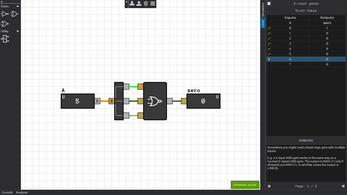
Truth table
levels where your goal is to build a circuit to match a given truth table, under certain restrictions (e.g. limited types of gates).
Sequential
levels where your goal is to create a circuit to match a given timing graph.
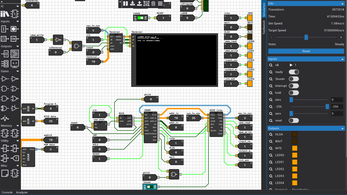
Stream
levels where you have to build a circuit to process several inputs streams and produce the desired outputs.
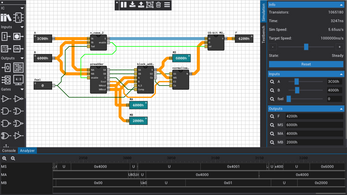
A powerful
sandbox editor
where you can build whatever circuit comes to mind! Includes a logic analyzer to debug your circuits, calculate propagation delays and/or find hazards and glitches. Create and organize components into packages and use them to create larger and better circuits.
WARNING: The macOS version has been tested only on Mojave. A few users reported that it doesn't work on newer versions.
Links
Discord
Sandbox (browser version)
Blog
GitHub (demo schematics & issue tracker)
Sandbox manual
DISCLAIMER
: This is an alpha version of the game. Although the simulator is capable of handling relatively complex circuits, you might find that certain configurations don't give the expected results. If this is the case, you can send us the schematic in question to find out what's going on and how we can fix the simulator.
Technical
DLS is a
time-driven event-based multi-delay 3-value
digital logic simulator.
Time-driven
means that the circuit time is advanced forward based on a user-specified target speed, which is measured in circuit nanoseconds per real second (ns/s). The simulation will always advance to a new state if there are pending signals in the circuit's queue. This means that even unstable or asynchronous circuits can be correctly simulated.
Event-based
means that a gate is simulated only if one of its inputs changes value. Otherwise the previous output is considered valid and used as input to all connected gates/components.
Multi-delay
means that each build-in g

![Wagotabi: Learn Japanese [Demo]](https://img.itch.zone/aW1nLzE2MzA0NzIyLnBuZw==/315x250%23c/odXIK%2B.png)